

Free Restaurant Profit and Loss (P&L) Statement Template
Get insights into your restaurant’s financial health with a free restaurant profit and loss (P&L) template
- See how your sales compare to your expenses
- Identify areas to lower expenses and increase revenue
- Completely customizable to your restaurant
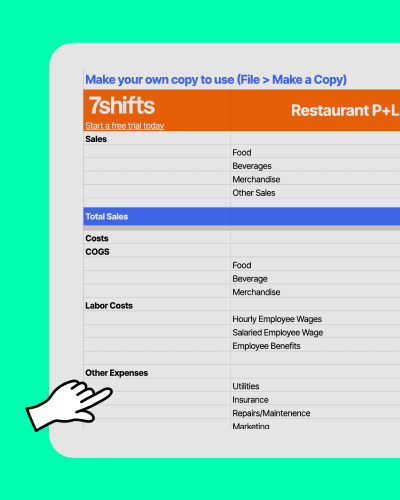

Profit & Loss Statement Template.xlsx
How to use your restaurant profit and loss template
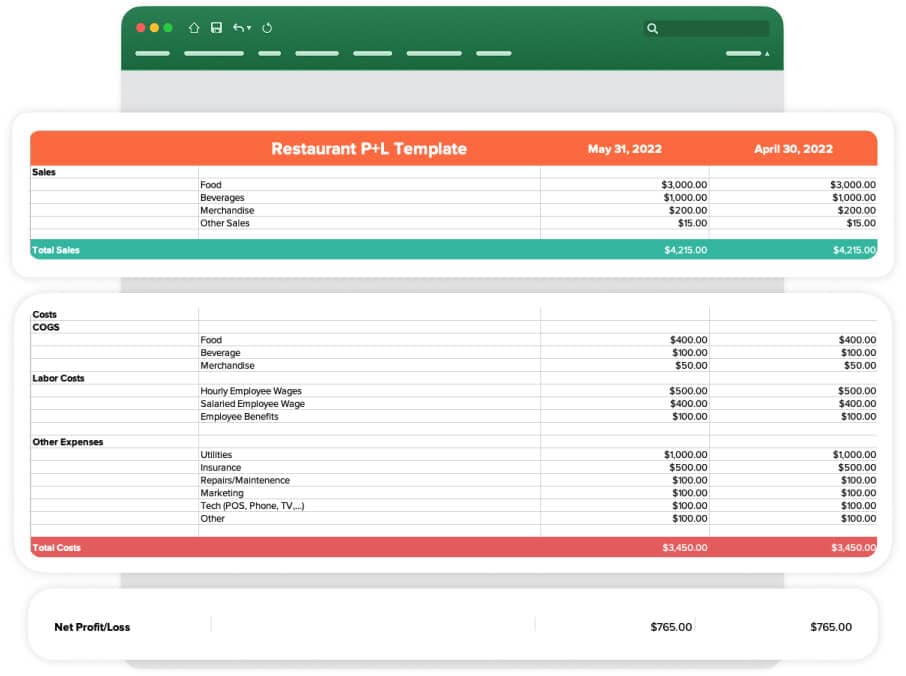
1. Add in your sales numbers.
2. Add in all your costs: CoGS, labor and operating expenses.
3. Calculate your total profits and losses.
4. Make adjustments accordingly to improve your restaurant’s financial health.

What is a profit and loss statement?
Also known as an income statement, the profit and loss statement (or P&L for short) measures a company’s total revenues, costs (expenses), and net profit over a period of time.

How often should you update your restaurant’s P&L statement?
We recommend that you update this template every week. This will let you catch anything abnormal before it has a negative impact on your business. We also recommend a monthly and yearly view to track all trend
That is just one piece of the puzzle








How does this free template stack up to 7shifts?
Compare how functionality of this Excel sheet against a robust team management platform like 7shifts.
 | Food Cost Template | |
| Easy schedule builder |  |  |
| Customizable to your restaurant | | |
| Free | | |
| Free mobile apps | |  |
| Communication tools (chat, announcement) | | |
| Automatic sales and labor reporting | | |
| Robust labor, sales, and compliance reports | | |
| Online manager log book | | |
| Labor budgeting tool | | |
| Labor compliance tools | | |
“It is SO easy to use. It is intimidating at first familiarizing yourself with the platform but after a few minutes it feels so natural using it. I used to do all of my scheduling on an excel spreadsheet. It would take two or three times as long as it takes me now on 7shifts.”

Eddie Cuellar
Restaurant owner, Tower Burger


“I was originally drawn to 7shifts because of their simple and easy interface for scheduling, but when I found out they also did payroll, it was a no-brainer. My employees onboarded via the 7shifts mobile app in 10 minutes and I'm already saving hours of time when it comes to processing payroll. Total game changer.”
Fahad Hanif
Owner/Operator, Halal Guys

“If you're a restaurant professional, this is a mandate. If this is a hobby for you, by all means, use something else. Use Excel, use post-it notes if you write it down. But if you're a professional and this is your career and your actual goal is to earn profit for your business, then there's no viable solution or anything that would make sense other than this. There just isn't.”
Mike Bausch
Owner, Andolini's


Find out why 1.5 million restaurant professionals love 7shifts

Frequently asked questions on restaurant P&L
A restaurant profit and loss statement breaks your business into a few big buckets so you can spot problems fast. At a high level, your restaurant P&L template should include:
- Total sales (often split into food and beverage)
- Cost of goods sold (CoGS) (what you paid for the food and drinks you sold)
- Labor costs (wages, taxes, benefits, and overtime)
- Operating expenses (rent, utilities, repairs, insurance, marketing, supplies, and more)
Once those are in place, you can calculate gross profit (sales minus CoGS) and net profit (sales minus all expenses). If you want a faster way to sanity-check staffing costs, a labor costs tool can help you confirm the math before you dig into the details.
Your P&L isn’t just a report for your accountant. It’s a weekly scoreboard for what happened on the floor and in the kitchen.
Start at the top with sales, then follow the money down the page. If sales are up but net profit is flat, something below the line is eating it—usually CoGS, labor, or a big operating expense like repairs.
To calculate net profit, subtract your total expenses (CoGS + labor + operating expenses) from total revenue. For example, if your restaurant brings in $80,000 in monthly sales and your total costs are $72,000, your net profit is $8,000, or a 10% profit margin. The average restaurant profit margin runs between 3–9%, so anything above that is a strong result. If your net profit is consistently low or negative, your P&L will show you exactly which cost category is eating into your margins so you can make targeted adjustments.
A profit and loss statement shows how much money your restaurant made or lost over a specific period—typically a week, month, or year—by comparing your revenue to your expenses. A balance sheet, on the other hand, is a snapshot of your restaurant’s overall financial position at a single point in time, showing what you own (assets), what you owe (liabilities), and what’s left over (equity). For day-to-day restaurant management, the P&L is the more useful document because it tells you whether your operations are profitable right now. Most restaurant owners review their P&L monthly at minimum, and weekly if they want to catch problems early.
Most restaurants operate on a net profit margin between 3–9%, though this varies by concept and service model. Full-service restaurants tend to run on the lower end (3–5%) due to higher labor costs, while quick-service and fast-casual concepts can push toward 6–9%. If your margin is consistently below 3%, your P&L is a good starting point for diagnosing whether the issue is food costs, labor, or operating overhead. Knowing your margin is the first step — knowing which line item is dragging it down is where the real work happens.
Cost of goods sold (CoGS) covers the direct cost of the food and beverages you sell — essentially, what you paid for the ingredients that went into each dish or drink. Operating expenses are everything else it costs to run your restaurant: rent, utilities, insurance, marketing, and equipment maintenance. Both categories show up on your P&L, but they’re tracked separately because they respond to different levers — you control CoGS through purchasing and menu pricing, while operating expenses are often more fixed. Keeping CoGS below 35% of revenue is a widely used target for most restaurant concepts.
Yes, but you’ll want a separate P&L for each location rather than combining everything into one sheet. Running individual P&Ls per location lets you compare performance across sites and quickly identify which location is underperforming and why. If you’re managing two or more locations, a platform like 7shifts can automatically pull labor cost data into your reporting, which saves you from manually entering one of your biggest expense line items every week.
Yes — a profit and loss statement and an income statement are the same document, just referred to by different names. Both show your total revenue, total expenses, and net profit (or loss) over a set period of time. In the restaurant industry, “P&L” is the more common term you’ll hear from operators and accountants. Regardless of what you call it, reviewing it regularly is one of the most important habits you can build as a restaurant owner.
Free Restaurant Management Templates
See all templates

Restaurant Schedule Template
Create staff schedules in less time with this free restaurant staff schedule template
Download now
Tip Pooling Template
Download the free excel tip pooling calculator to help determine and distribute tips to your employees using tip pools.
Download now
Manager Log Book Template
Download the log book template to help managers keep track of what's going on in your business.
Download now
Restaurant Budget Template
Get the restaurant budget template to determine the budgeting of your restaurant.
Download now