

Free Tip Pooling Policy Template
Make tip distribution clear with this tip pooling policy template
- Lay out the tip pool breakdown for staff to understand
- Collect employees’ written agreements for your records
- Customize the template to match your needs
 Lay out the tip pool breakdown for staff to understand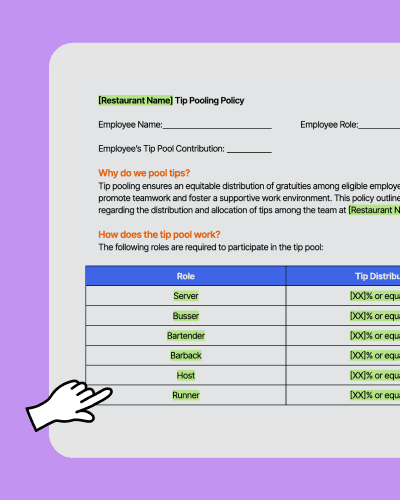

Tip Pooling Policy Template
How to use your tip pooling policy template
Avoid any staff confusion on the tip pool with the editable template.
1. Open the template and click File > Make a copy. You can also download it in another format.
2. Replace any highlighted text with your own information.
3. Save the changes.
4. Share with employees.

All about tip pool policies
What is a tip pooling policy?
A restaurant tip pooling policy (sometimes called a tip pool agreement, tip distribution policy, or written tip policy) is a documented set of rules that spells out how tips are collected and shared among your team. Think of it as the official answer to "how does this work?" so nobody's guessing on payday.
Why is a tip pooling policy needed?
Without a written policy, tip distribution becomes a source of confusion, disputes, and even legal risk. A clear policy protects both the business and employees by setting transparent expectations from day one. It also helps you stay consistent, especially as your team grows or staff turns over—and it creates a paper trail if questions ever come up around compliance.
The template is just the beginning









How 7shifts helps with tip pooling

Create custom tip pools that fit your teams’ needs
Our simple rule creator lets you create as many pools as your restaurant needs in under a minute. You’re in control of where the tips are coming from, which roles receive from the pool, and how distribution is calculated.

Save time and effort with automated tip calculations
Stop cross-referencing reports from different systems or manually pulling tip data every week. Combine your custom tip rules with the data from your POS or 7punches to automatically calculate tip distribution.

Pay your team in seconds
Tips sent through Tip Management arrive in employees’ accounts instantly and automatically.
“It is SO easy to use. It is intimidating at first familiarizing yourself with the platform but after a few minutes it feels so natural using it. I used to do all of my scheduling on an excel spreadsheet. It would take two or three times as long as it takes me now on 7shifts.”

Eddie Cuellar
Restaurant owner, Tower Burger


“I was originally drawn to 7shifts because of their simple and easy interface for scheduling, but when I found out they also did payroll, it was a no-brainer. My employees onboarded via the 7shifts mobile app in 10 minutes and I'm already saving hours of time when it comes to processing payroll. Total game changer.”
Fahad Hanif
Owner/Operator, Halal Guys

“If you're a restaurant professional, this is a mandate. If this is a hobby for you, by all means, use something else. Use Excel, use post-it notes if you write it down. But if you're a professional and this is your career and your actual goal is to earn profit for your business, then there's no viable solution or anything that would make sense other than this. There just isn't.”
Mike Bausch
Owner, Andolini's


Find out why 1.5 million restaurant professionals love 7shifts

Frequently asked questions on tip pooling policies
While federal law under the Fair Labor Standards Act (FLSA) doesn’t explicitly require a written tip pooling policy, having one is strongly recommended (and some states do require written notice to employees about tip arrangements). A written policy protects your restaurant if a staff member disputes how tips were divided, and it creates a clear paper trail that demonstrates your process was fair and consistent. Without documentation, you’re relying on verbal agreements that are nearly impossible to defend. A signed policy agreement is one of the simplest ways to reduce your legal exposure around tip distribution. Requirements vary by location—check your state and local regulations.
Yes — a tip pooling policy template can be customized for each location, which is especially useful if your restaurants have different staffing structures or tip distribution rules. For example, a full-service location might split tips between servers, bussers, and food runners, while a fast-casual location might use a simpler equal-share model. The key is to make sure each location’s policy reflects its actual practice, and that employees at each location sign their own copy. If you’re managing multiple locations, a platform like 7shifts lets you set up separate tip pool rules for each location so the math is handled automatically.
Tip pooling means all tips collected during a shift go into a shared pool, which is then divided among a group of employees based on a set formula — like hours worked or role. Tip sharing (sometimes called “tipping out”) is when individual servers keep their own tips but contribute a percentage to support staff like bussers or bartenders. Both approaches need a clear written policy so your team knows exactly what to expect on payday.
No — under the federal Fair Labor Standards Act, managers and supervisors are prohibited from participating in a tip pool, even if they regularly perform tipped work like serving or bartending. Owners are also excluded. Including them — even unintentionally — can expose your restaurant to significant legal liability and back-pay claims. Your tip pooling policy should explicitly name which roles are eligible and which are not. Requirements vary by location, so check your state and local regulations.
The simplest approach is to have each employee read the policy and sign a copy before their first shift — or before you roll out a new tip arrangement. Keep a signed copy on file for every employee, and make sure the policy is easy to access if someone has questions later. The tip pooling policy template can help with this purpose, so you don’t have to build one from scratch.
You should review your tip pooling policy any time your staffing structure changes, you add a new role to the pool, or tip distribution rules shift — and at minimum once a year. Tip pooling laws also change at the state level, so it’s worth checking your local regulations annually to make sure your policy stays compliant. Any time you make a change, have employees sign an updated copy so your records stay current.
Inconsistent enforcement is one of the most common reasons tip disputes escalate into formal complaints or legal claims. If your policy says tips are split by hours worked but a manager occasionally overrides that, employees have grounds to question whether the arrangement is fair — or legal. A written policy that’s applied the same way every shift is your best protection. Using automated tip calculations through Tip Management removes the manual step entirely, so the math is always consistent and documented.
Free Restaurant Management Templates
See all templates

Tip Pooling Calculator Template
Tip pools are complicated. This template makes it easier. Simply fill in the employee hours and the tip amounts and the spreadsheet calculates the payout for you.
Download now
Restaurant Employee Training Manual Template
Set your staff off on the right foot with the editable training manual.
Download now
Restaurant Schedule Template
Get the best restaurant excel-file schedule template to help create your staff work schedules.
Download now
Labor Cost Calculator Template
Track hours worked by your restaurant staff.
Download now