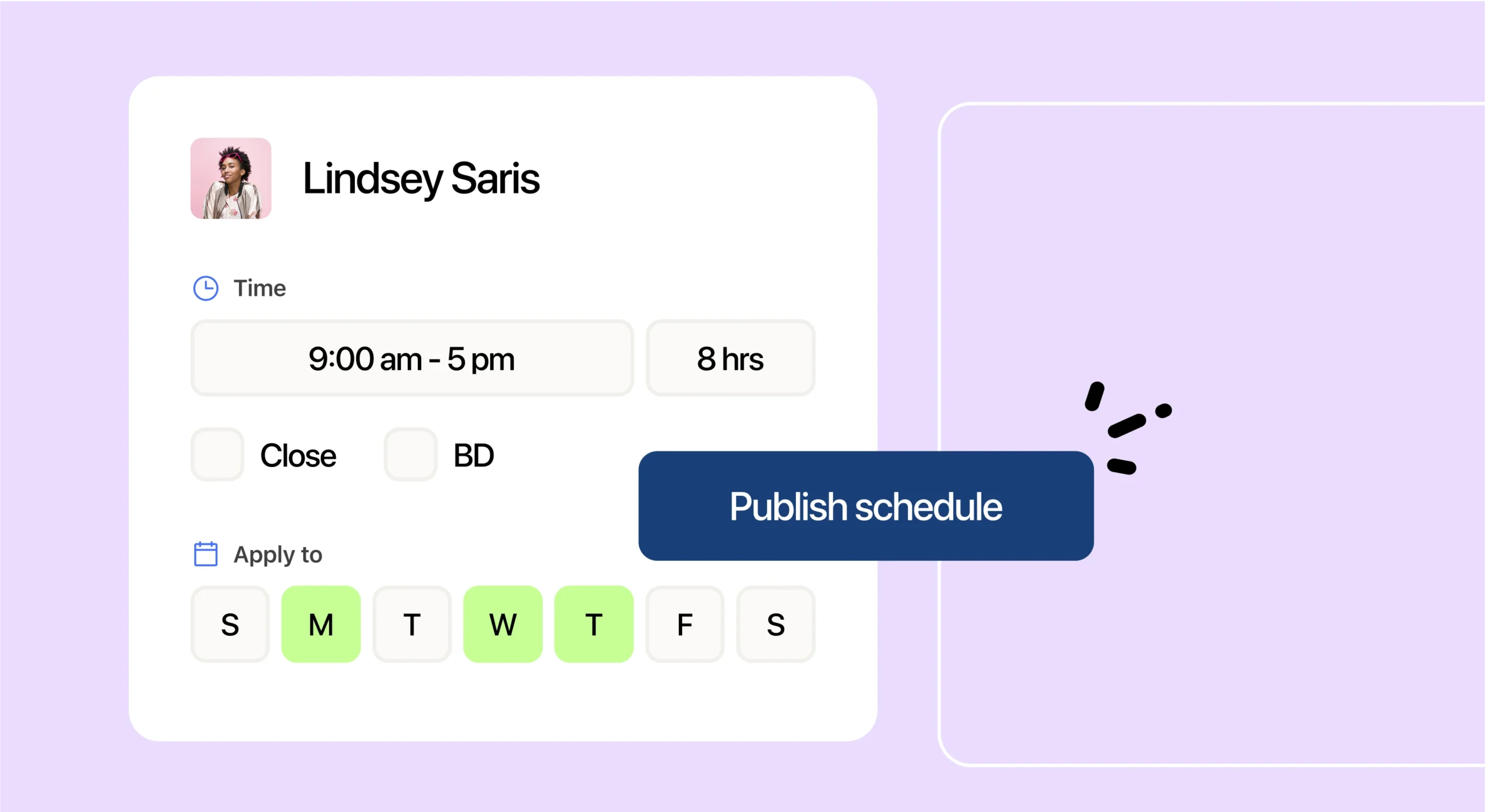
Employee scheduling for your restaurant can be the most stressful part of your job. After tracking sales, calculating inventory, and just trying to keep your head above water, building a schedule can eat hours out of your week. And that schedule almost never goes as planned.
Problems pop up constantly — your head chef calls out sick an hour before service, or half the team asks for the same weekend off. You’re always either understaffed or overstaffed in the front-of-house (FOH) or back-of-house (BOH), at the worst times. A bad schedule means too many people on slow nights, not enough during the rush, overtime surprises you didn’t budget for, and frustrated staff browsing job boards.
There’s no such thing as a perfect schedule, but there are proven methods that get you a better one in less time. This guide covers 11 restaurant staff scheduling tips that work — plus common challenges, shift types, and answers to the questions operators ask most — so you can spend less time on the schedule and more time on the floor with your team.
What is restaurant staff scheduling?
Restaurant staff scheduling is the process of assigning employees to shifts based on forecasted demand, role coverage, labor budgets, and staff availability. It’s the weekly puzzle every operator solves: how many people do you need, when do you need them, and who’s actually available to work?
Done well, restaurant shift scheduling controls labor costs, reduces turnover, and keeps service consistent across every daypart. Done poorly, it leads to unplanned overtime and burnout among your strongest team members — the employees you can least afford to lose. With the accommodation and food services sector consistently posting some of the highest quit rates of any industry, getting scheduling right has a direct impact on whether your team sticks around.
What makes restaurant scheduling different from other industries is the sheer number of moving parts — variable demand that shifts by the hour, tipped employees with unique pay structures, multiple shift types running simultaneously, and a web of compliance requirements that change by state and city.
Free Scheduling Template Download
Simplify your scheduling with our free, ready-to-use template.

Common restaurant scheduling challenges
Before diving into solutions, it helps to name the problems. If any of these sound familiar, you’re not alone — they’re the same challenges restaurant operators deal with every week. And they’re expensive: 7shifts research shows that replacing an employee can cost $1000-2000 when you factor in recruiting, training, and lost productivity.
- Last-minute call-outs and no-shows. Someone texts you an hour before their shift, and now you’re scrambling to find coverage with no backup plan. It happens more often than anyone wants to admit.
- Over- or under-staffing. Without hard data, you’re guessing how many people you need — and guessing wrong means wasted labor dollars on slow nights or long ticket times when it’s slammed.
- Overtime surprises. When you’re not tracking hours closely, an employee creeps past 40 hours before you notice. By then, the cost is already on the books.
- Late schedule posting. Publishing the schedule a few days ahead instead of two weeks out creates conflicts, resentment, and a flood of swap requests that land in your lap.
- Compliance blind spots. Missing break requirements, predictive scheduling laws, or overtime thresholds can lead to fines and lawsuits — and the rules aren’t the same everywhere. Requirements vary by location — check your state and local regulations.
Types of restaurant shifts
Not every shift looks the same, and your schedule needs to account for that. Here are the most common restaurant shift types you’ll work with:
- Morning / opening shift. Prep, setup, and early-bird service. Your openers set the tone for the entire day.
- Mid shift. Covers the lunch rush and often overlaps with both the morning and dinner crews. Useful for bridging gaps in coverage.
- Dinner / evening shift. The highest-volume shift in most full-service restaurants. This is where your strongest team needs to be.
- Closing shift. Breakdown, cleaning, and prep for the next day. Closers handle the work nobody sees but everyone depends on.
- Split shift. Two separate blocks in one day — for example, lunch and dinner with a break in between. Common in full-service restaurants, but tough on staff if overused.
- On-call / standby shift. The employee isn’t scheduled to work but stays available if you need them. A safety net for high-volume or unpredictable nights.
One shift pattern to watch out for: the “clopen,” where an employee closes the restaurant at night and opens it the next morning. Clopens leave staff with too little rest and hurt morale fast. More on that below.
11 scheduling tips that actually work
1. Cross-train your employees
If you’re one busser down on your busiest night of the week, your table turn times will slow down — and so will your waitlist. This leaves your guests waiting longer for a table that should have been cleared 10 minutes ago. To avoid a backlog like this, have your food runners, servers, or even front-of-house managers familiar and comfortable with bussing. This way, they can pitch in where needed so you can empty your waiting area and increase customer satisfaction.
Cross-training restaurant employees can also be beneficial for their career advancement. Having a busser or food runner check in with a table if the server is busy can give them experience with customer interaction. If one of your guests asks the hostess what the drink specials are for the night, they won’t have to call over a server because they’ll know it already. Cross-training keeps your staff productive on slow shifts and gives them a real path to take on more responsibility in your restaurant.
2. Schedule around demand, not gut instinct
If your plan for every single shift is to have one hostess, three cooks, one bartender, and two servers, you may have noticed you’re frequently over- or under-staffed. Instead of guessing or using a “one size fits all” approach for your schedule, make a concrete and data-based decision.
Check your sales reports from your point of sale (POS) to see when your restaurant is at its busiest. That way, you can plan for the variation at different points of the day, week, and year.
Start by staffing your peak hours first. Build around your lunch rush, Friday and Saturday dinner, and any other high-volume windows before filling the slower periods. This keeps your strongest coverage where it matters most and prevents the common mistake of spreading staff evenly across every shift regardless of demand.
With the data your system gathers, you can start to prove — or disprove — your managerial hunches. For example, even though Saturday has always been your busiest day of the week, the data often shows that the bulk of the business comes from the lunch rush, not dinner. Based on that, you can shift your restaurant employee scheduling around so you won’t be understaffed at lunch or overstaffed at dinner.
Historical data from the same week last year can also help you account for seasonal swings and avoid repeating the same staffing mistakes. This strategy works especially well for restaurants that deal with fluctuation in business due to seasonality. Tools like 7shifts can integrate with your POS to forecast sales and optimal labor based on your actual sales data.
Recommended Reading: 9 Steps On How to Schedule Employees Effectively
3. Collect availability and time-off requests early
Your employees are human beings — they’ll need vacations, time off, and time to see their kid’s dance recital. This time off helps boost overall productivity and engagement. In your time running your restaurant, you’ve come to accept this reality — but it’s better to have your employees alert you of these requests earlier rather than later.
Instead of dealing with employees asking you for a day off at the last minute, ask them to bring up scheduling conflicts and time-off requests as soon as possible. This way, you can avoid changing the schedule after you’ve set it — a decision that can frustrate other members of your staff and throw off the balance of your restaurant scheduling. Make it easy for your team to submit availability and requests digitally rather than relying on texts, sticky notes, or hallway conversations that get lost in the chaos of a busy shift.
4. Build in on-call coverage
While restaurant data helps you predict your sales, out-of-the-ordinary scenarios like weather or special events can result in your restaurant being busier or slower than you had expected. Not to mention the headaches that come with unexpected situations like sick relatives, flat tires, or the impromptu “I quit!”
To account for this, schedule with on-call employees in mind. This way, if you need to call in an extra cook and server when things pick up on your busiest shift, they won’t be caught off guard when they hear from you.
For your slowest predicted shifts, slightly under-schedule and keep one employee on-call. This way you won’t have employees slacking off from a lack of work. On-call employees can also save your shift when someone cancels at the last minute. This kind of built-in flexibility is one of the simplest ways to create a schedule that adapts to real conditions instead of falling apart when things don’t go as planned.
5. Balance experience across every shift
You know the mix of front-of-house and back-of-house roles you need for every shift. But it’s worth taking the mix of staff roles a step further and scheduling based on experience.
Restaurant employee scheduling planned around experience means you have a more well-rounded team for any given shift. After all, would you leave your restaurant in the hands of employees who have all been in their respective roles for under three months? If you hired two new servers last week, would you want both of them working during the same Friday evening shift? Is putting your two strongest chefs in the kitchen together on the same night worth it if it means you’ll be without them on another night?
Balance by role type too. Make sure every shift has the right FOH-to-BOH ratio, not just the right headcount. For example, pairing a new server with an experienced one during a Friday dinner rush gives the new hire a safety net and keeps service consistent for your guests.
Take some time to consider the hierarchy and experience of your staff, and make the proper adjustments. This way, your team will always have a similar level of experience, which adds consistency to your restaurant at all times.
6. Post the schedule at least two weeks out
Sending out the schedule two weeks in advance isn’t just the right move for your employees’ lives — in many cities, it’s also the law. Predictive scheduling laws now exist in several states and cities, requiring employers to post schedules 10 to 14 days in advance. Research from the Brookings Institution found that these laws can benefit both workers and the business’s bottom line. Requirements vary by location — check your state and local regulations. The benefits of scheduling ahead of time are twofold:
First, you’ll give employees ample time to plan out their lives, which means your team can plan better, call out less, and show up ready to work. It gives them the ability to plan days off with family, friends, or even take a trip. Time off is most restorative when it’s planned in advance — and while you can’t plan someone’s day off for them, you can give them enough lead time to do it themselves.
Second, you’ll have more time to adjust and make changes to the schedule. No one wants a last-minute change of shift that needs filling. By scheduling out in advance, you can decrease the likelihood of having to make game-time decisions.
7. Avoid clopening shifts
A “clopen” is when an employee closes the restaurant at night and then opens it the next morning — sometimes with as little as five or six hours between shifts. It’s an easy way to burn out your team.
The impact goes beyond tired staff. Fatigued employees make more mistakes on the line and are far more likely to start looking for a new job. If you’re dealing with high turnover, clopens are often a hidden driver.
When building your restaurant shift scheduling, set a minimum gap of 10 to 12 hours between a closing and opening shift for the same employee. It’s a small adjustment that pays off in fewer call-outs, fewer errors, and a team that actually wants to show up.
8. Use scheduling software (and let it auto-schedule)
If you’re still using pen and paper, whiteboards, or excel scheduling templates and spreadsheets to make your schedule, it’s time to move on. The manual approach worked when you had 10 employees and one location — but once you’re juggling 30-plus staff across shifting demand, spreadsheets can’t keep up.
Scheduling software puts everything in one place: drag-and-drop schedule building, mobile access so your team can check shifts from their phone, built-in shift swaps, availability tracking, and overtime alerts before they become overtime costs. Still on the fence? Here are 5 signs you need to switch from excel to scheduling software.
Then there’s auto-scheduling — the next step up. Instead of building every shift by hand, the software creates the schedule for you based on demand that is accurately forecast, staff availability, labor budgets, and compliance rules. Auto-scheduling handles the heavy lifting so you can focus on running the floor instead of wrestling with a spreadsheet. Look for restaurant staff scheduling software built specifically for operators, not a generic workforce tool repurposed for food service.
9. Give staff two consecutive days off
What’s better than a day off? Two days off. While many jobs outside of the restaurant industry follow a Monday through Friday schedule with weekends off, restaurant industry employees rarely see a Saturday or Sunday off.
Two days off in a week is still most common, but restaurant workers often see those days split up during the workweek. When building your schedule, try to give employees consecutive days off to rest, recharge, and enjoy time with friends and family.
2026 Labor Costs Playbook
Increase your bottom line with insights from over 500 restaurant pros—learn the true cost of employee turnover, the best way to manage labor costs, and proven strategies to protect profits.
10. Stay on top of overtime and labor laws
The last thing you want is to eat a lot of overtime costs by scheduling an employee more than 40 hours, or be forced to pay hefty fees when you accidentally break compliance laws. No matter how diligent you are in scheduling, mistakes can — and will — still be made.
The key risks to watch for: unplanned overtime that blows up your labor budget, missed break requirements that trigger penalties, and predictive scheduling violations in cities where those laws apply. Requirements vary by location — check your state and local regulations.
The simplest way to stay ahead of overtime and compliance issues is to use scheduling software that automatically flags both. Tools like 7shifts have built-in labor law compliance that alerts you when staff is scheduled into overtime, when breaks aren’t built in, and when shifts violate local rules — so you catch problems before they hit the books.
11. Schedule with empathy
Don’t let a schedule become a list of names. Remember that everyone on your team has unique life circumstances that must be accounted for when building the schedule. College classes, kids at home, second jobs, and other responsibilities all factor into someone’s availability. Mike Bausch of Andolini’s in Tulsa calls this “scheduling with empathy” — and it’s a real reason his team keeps showing up.
Frequently asked questions about restaurant scheduling
How do I schedule staff for a restaurant? Start by identifying your peak hours using POS sales data, then build coverage for those shifts first. Factor in each employee’s availability, role, and experience level. Post the schedule at least two weeks ahead so your team can plan around it. The goal is to match the right people to the right shifts — not just fill slots.
How far in advance should a restaurant schedule be posted? At least 14 days (two weeks). Some cities and states have predictive scheduling laws that require 10 to 14 days of advance notice. Even where it’s not required by law, posting early reduces last-minute conflicts and boosts morale. Requirements vary by location — check your state and local regulations.
What is a clopening shift, and why should I avoid it? A clopening is when an employee closes the restaurant at night and opens it the next morning, leaving too little time to rest. Clopens lead to fatigue, mistakes, and higher turnover. Build at least 10 to 12 hours between a closing and opening shift for the same employee.
How do I handle last-minute call-outs? Keep a short list of trained on-call staff who are available to cover gaps. Pair this with a shift-swap system so employees can trade shifts among themselves without waiting for manager approval. The fewer bottlenecks in the process, the faster you fill the gap.
How do I stay compliant with labor laws when scheduling? Track scheduled hours to catch overtime before it happens, build required breaks into every shift, and follow predictive scheduling rules where they apply. Scheduling software can flag compliance risks automatically. Requirements vary by location — check your state and local regulations.
What is the best restaurant scheduling software? The right tool depends on your restaurant’s size and needs, but look for features like auto-scheduling, labor cost tracking, mobile access for your team, and built-in compliance alerts. A platform built specifically for restaurants will handle nuances like tip tracking and multi-location scheduling that generic tools miss.
How do I create a flexible schedule for a busy restaurant? Cross-train your team so employees can cover multiple roles, collect availability early, and keep on-call staff ready for high-volume shifts. Use historical sales data to predict demand rather than guessing, and give your team the ability to swap shifts on their own. Flexibility comes from preparation, not from winging it.

Rebecca Hebert, Sales Development Representative
Rebecca Hebert
Sales Development Representative
Rebecca Hebert is a former restaurant industry professional with nearly 20 years of hands-on experience leading teams in fast-paced hospitality environments. Rebecca brings that firsthand knowledge to the tech side of the industry, helping restaurants streamline their operations with purpose-built workforce management solutions. As an active contributor to expansion efforts, she’s passionate about empowering restaurateurs with tools that genuinely support their day-to-day operations.
