Oklahoma’s minimum wage has remained the same as the federal rate of $7.25 per hour since 2009. And while the law hasn’t moved, the reality of running a business has. Owners have to take note of inflation and competition, which means needing to offer better compensation. However, this can impact margins as well. Knowing the current wage laws and potential changes can help you stay ahead.
What is the minimum wage in Oklahoma in 2026?
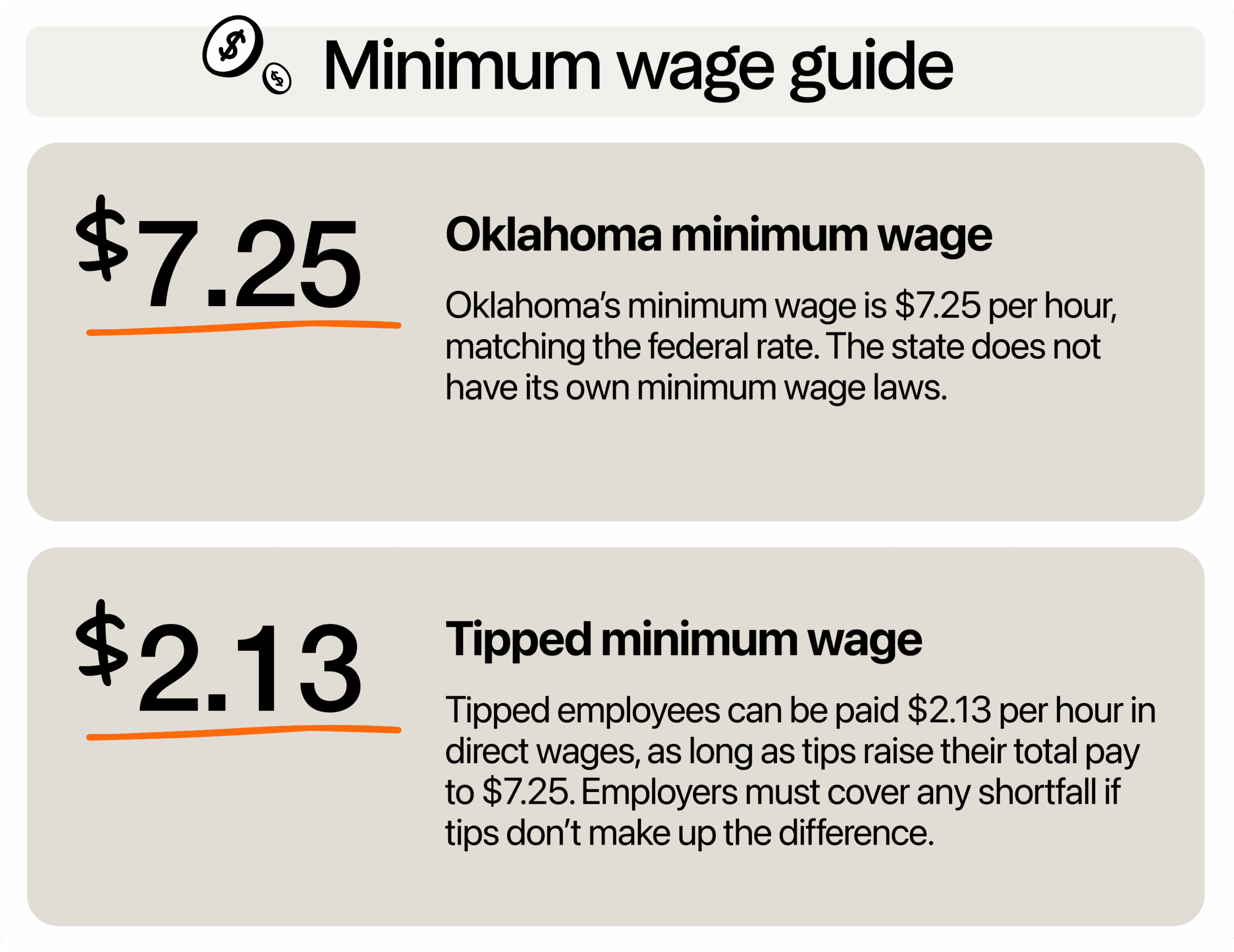
The minimum wage in Oklahoma in 2026 is $7.25 per hour, following the federal minimum set by the Fair Labor Standards Act (FLSA). The state hasn’t created laws to publish its own rate.
For tipped roles, like servers or bartenders, you can pay a direct wage of $2.13 per hour in cash, as long as their tips bring their total pay up to at least $7.25. For example, if a server earns $4.50 per hour in tips, you’d still need to add $0.62 per hour on top of the cash wage so they reach that full minimum.
Minimum wage exemptions
In some cases, you can pay subminimum. Workers under 20 years old can be paid $4.25 per hour during their first 90 days on the job. Meanwhile, full-time students (in high school or college) working certain jobs can earn $6.16 per hour.
The size of your business can also help you qualify for minimum wage exemptions. Small businesses with fewer than 10 employees at a location or under $100,000 in annual sales may legally pay as low as $2 per hour if they’re not covered by the federal minimum law.
There are also exceptions for workers with disabilities under certain federal programs. To qualify, a business must apply for and receive a special certificate from the U.S. Department of Labor. This program is often used in nonprofit settings, but for-profit restaurants may apply if they meet the criteria and follow strict recordkeeping and documentation rules.
While controversial, the 14(c) program still exists in 2025 and can be a legal way for small businesses to hire differently-abled workers at a lower rate. However, you can set yourself apart and demonstrate being a compassionate employer by paying at or above minimum wage.
How does Oklahoma’s minimum wage compare to neighboring states?
Oklahoma falls behind some of its neighbors when it comes to pay. Arkansas minimum wage is $11 per hour, while Missouri and Colorado pay $15 and $15.16, respectively. Only Kansas and Texas match Oklahoma at $7.25 an hour.
This matters for businesses near borders or those operating in multiple states. Your staff may be comparing wages across state lines, and if they can earn $3 to $7 more per hour just by working across the border, it could impact your ability to retain them.
The wage gap becomes even more significant when we consider what it actually takes to live in Oklahoma today. In 2025, the MIT Living Wage Calculator estimates a single adult living in The Sooner State to need at least $20.26 per hour to cover basic living expenses like housing, food, transportation, and healthcare.
For two adults living together, the ideal wage bumps to $28.38, and they’d need to earn at least $34.48 each if they have a child. As you can see, Oklahoma’s minimum wage falls way short, especially for full-time restaurant workers supporting themselves or their families.
Are there plans to increase wages from $7.25?
State Question 832 (SQ 832) is a citizen‑led ballot initiative set for a statewide vote in the June 2026 primary. If approved, it would gradually raise Oklahoma’s minimum wage from the current state rate all the way to $15 per hour by 2029.
The proposed schedule calls for $9 per hour in 2025, $10.50 in 2026, $12 in 2027, $13.50 in 2028, and $15 in 2029, after which annual increases would follow the CPI‑W measure. However, because the vote is delayed until 2026, some elements of the early timeline may shift. That means if SQ 832 passes, the first effective wage increase may kick in in January 2027, with a jump straight to $12 per hour, skipping the earlier steps in practice.
Oklahoma lawmakers have repeatedly tried, and failed, to pass minimum wage increases through formal legislation. For years, bills such as SB 1276 stalled in committee without action. Fortunately, citizen-driven ballot initiatives like SQ 832 offer a way to change OK’s wage law.
If the initiative passed, the obvious benefits for employees would be to reduce poverty and financial insecurity. It may also boost consumer spending, and restaurants might see increased customer traffic as workers have more disposable income.
However, small businesses may struggle to absorb the jump in labor costs, which could push some operators to cut hours or even jobs. This makes planning even more critical for employers to protect their margins while staying compliant and competitive.
What happens if SQ 832 passes?
If Oklahoma voters approve State Question 832, restaurant labor costs could start rising as early as January 2027. Anyone paying the current $7.25 per hour minimum wage needs to get ahead of the change. Planning now gives you time to adjust pricing, staffing, and roles, rather than scrambling once the increases hit.
Start by building wage cost models that reflect the proposed SQ 832 timeline. Forecast labor expenses based on your current staffing mix, and layer in the upcoming wage ramps.
You’ll want to adjust your pricing strategy well before 2027. For example, even a 10% to 15% lift in labor cost may require portions, menu items, or shift pricing tweaks. Check margins and product mix now so you don’t get squeezed later.
It’s also smart to rethink staffing structures: reposition team members into roles that can earn performance-based pay, or take on more multi-skilled positions to save on hours. Review your budgets yearly, and build in buffers for each wage hike to avoid surprises.
2026 Labor Costs Playbook
Increase your bottom line with insights from over 500 restaurant pros—learn the true cost of employee turnover, the best way to manage labor costs, and proven strategies to protect profits.
How does one stay competitive with federal minimum wages?
The best way to stay competitive is to offer higher pay as much as you can. Even raising your starting rate to $8 per hour can help you stand out from other employers that pay only the minimum. However, if you’re not in a position to increase wages right now, there are still strategies you can use to compete for talent and keep your best people around.
Offer non-monetary perks
First, you can offer non-monetary perks to help you compete for great employees. These are low-cost or no-cost benefits that make your restaurant a better place to work.
Start with free or discounted meals. Feeding your team during long shifts is one of the easiest ways to show your team you care. It doesn’t have to be your most expensive item. Even a basic sandwich, salad, or rice bowl can save a team member $10 to $15 per shift.
That adds up fast, especially for employees stretching every dollar. Over a week, that’s like giving them an extra $50 in value, without having to sacrifice your margins.
You can also let them take home leftovers or extra prep at the end of the night. For example, if there’s extra rice, beans, or roasted veggies, package them up and offer them as a “team meal” after closing.
Next, offer flexible scheduling. Let staff request time off easily or swap shifts without worrying about complicated management processes. People stay longer when they feel like their manager understands they have lives outside of work.
Restaurant scheduling software like 7shifts lets employees request time off and change their availability right on the app. This gives them more control over their work-life balance.
Also consider benefits like first pick of shifts for top performers or paid time off on birthdays. Even free uniform laundry or a locker with their name on it can make your team feel valued.
These benefits cost much less than raising everyone’s hourly rate, but can still help you stand out from other employers paying minimum wage. When staff feel respected and taken care of, they’re more likely to stick around, even if your pay rate isn’t the highest in town.
Provide clear growth plans
Another way is to pave the way for long-term restaurant careers in your establishment. People don’t want to stay stuck. When workers see a future with your restaurant, they’re more likely to stay, even if they start with minimum pay.
Write down roles and steps. For example, show how a dishwasher can become a prep cook and then move up to line cook or shift lead. Make it simple and visual. Use a chart or list posted in the break area. Let new hires know you promote from within and follow through when someone shows promise.
For training, use short checklists as you teach team members new tasks. When someone learns how to close the register or lead side duties, recognize it and bump their title, or hours. If you can’t raise pay yet, reward growth with perks like better shifts, shout-outs, or first pick for time off.
To build on your growth strategy, schedule quick one-on-one talks with your staff every month. Ask them what they want to learn, then give them goals and feedback.
For instance, you can give your most reliable team member a shot at running a shift and, if they excel, promote them to assistant manager. By investing in your team’s skills and creating a path forward, you show that your restaurant values personal and professional development.
Know your labor cost per item
Aside from tweaking your job offers, you also need to know exactly how much each menu item costs you, including labor. Most restaurant owners track food cost, but forget to factor in the time it takes to prep, cook, and plate each dish. That time adds up, and it eats into your profit if you’re not careful.
Check how long it takes your staff to make a dish, from prep to serve. If it takes 5 minutes to make a burger and your cook earns $7.25 per hour, that’s about $0.60 in labor per burger. Add that to the cost of ingredients to get the true cost.
Do this for every popular item on your menu. Then look at which ones have the highest labor costs. Maybe your chicken sandwich takes 12 minutes to prepare, but sells for the same price as your taco plate that takes half the time. If so, you’re losing time and money without realizing it.
Use these numbers to improve. You might raise prices on time-heavy items or prep ingredients in bulk to speed up the line. You can also swap out certain dishes with faster options to keep labor costs low during peak hours.
Knowing the true cost per item helps you manage labor cost percentage, even if you’re paying minimum wage. By tracking metrics meticulously, you’ll spot opportunities to optimize workflow and reduce unnecessary expenses, which you can potentially reinvest into employee compensation.
Use referral bonuses
Finding good staff is tough, especially when you can’t offer more than the minimum. Bring in reliable people through referral bonuses. Your best workers probably know others like them. Give them a reason to help you hire.
Start simple and offer a cash bonus when a current team member refers to someone who gets hired and stays for a set amount of time, like 30 or 60 days. A common setup is $50 when the new hire starts, and another $50 after they stick around for two months. That’s enough to motivate, but it’s still cheaper than spending hundreds on job ads or hiring agencies.
Referral bonuses also build trust. You’re showing your team you value their judgment and want more people like them. Plus, referrals usually lead to better hires, with 45% generally staying longer than four years.
To get started, print a simple flyer and post it in the break room. Include how much the bonus is, how to submit a name, and when the bonus gets paid. You can also announce the referral program at a pre-shift meeting and follow up with a message in your team’s scheduling app.
Celebrate wins publicly
Public recognition is a great tool to boost employee engagement and, in turn, retention. Celebrating your team’s hard work doesn’t cost anything, but it builds pride, boosts morale, and makes people want to stick around.
Use your pre-shift meetings to call out good work from the day before. Acknowledge a team member and thank them when they handled a tough customer, picked up an extra shift, or stayed late to help clean. Even 30 seconds of praise in front of the team can make someone’s day.
You can also use a whiteboard or team communication app to highlight wins. Try posting “Employee of the Week” or a “Shout-Out Wall” where staff can write notes to each other. It helps build a positive culture and encourages teammates to lift each other up.
Small rewards help, too. Give out a $10 gift card, a free dessert, or first pick of shifts to staff who go above and beyond. If you use an app, add notes to someone’s profile so other managers see their strong performance.
It’s easy to overlook the small wins in a busy restaurant. But celebrating them in front of the team builds pride, loyalty, and energy, which makes your whole operation stronger.
How to talk to your team about wages
Talking to your team about wages can feel uncomfortable, especially if you’re still starting with the Oklahoma minimum rate. But the truth is, clear and honest conversations about pay information can build trust and boost morale, even if you can’t raise wages right away. Most employees don’t expect magic. They just want to feel respected, heard, and in the loop.
Be transparent. Let your team know why you’re only able to offer the state minimum. If you’re stuck there because of tight margins, say so. Tell them that the restaurant is still working hard to stay profitable, which is why you can only offer $7.25 per hour for now.
Then talk about what’s next. If you have plans to raise pay in the future, share the criteria. Maybe it’s based on sales growth, lower food waste, or a timeline like “after 6 months with the team.” Be specific and stick to things you can actually deliver. A broken promise does more damage than silence.
Also highlight non-wage perks you’re already offering, like free meals, flexible scheduling, referral bonuses, or growth paths. These aren’t a replacement for fair pay, but they show you’re doing what you can with what you’ve got.
Most importantly, check in often. Ask your staff how they’re feeling about work, not just wages. Communicating with them regularly shows that you care about more than just what they bring to your restaurant. Rather, it demonstrates that you’re invested in their growth and well-being.
You don’t need to overpromise to keep your team engaged. You just need to be real with them. When staff trust you, they’re more willing to stick around, even if the paycheck isn’t perfect yet.
Stay competitive at any wage level
The minimum wage rate in Oklahoma hasn’t changed in years, but your strategy should. As costs go up and labor trends shift, staying competitive means more than just meeting legal requirements. Plan ahead and implement strategies to offer more value without overextending your budget. Small changes now can make a big difference in how you recruit, retain, and succeed.
Start by creating efficient schedules with 7shifts. Our restaurant management software lets you build shifts based on staff availability, forecasted sales, and past labor trends, so you’re never over- or understaffed. Manage labor costs all in one app, so you can focus on strategic staffing decisions even with current wage rates.

Rebecca Hebert, Sales Development Representative
Rebecca Hebert
Sales Development Representative
Rebecca Hebert is a former restaurant industry professional with nearly 20 years of hands-on experience leading teams in fast-paced hospitality environments. Rebecca brings that firsthand knowledge to the tech side of the industry, helping restaurants streamline their operations with purpose-built workforce management solutions. As an active contributor to expansion efforts, she’s passionate about empowering restaurateurs with tools that genuinely support their day-to-day operations.