Tennessee’s minimum wage, which has remained the same since 2009, can make it a challenge to keep high-performing employees. Without competitive pay or a clear path to grow, even your best team members may feel stuck or undervalued. They may start looking for better pay, especially in neighboring states like Missouri and Virginia.
Understanding TN labor laws and compensation trends can help you create strategies that build up your team and, ultimately, your restaurant.
What is the minimum wage in Tennessee in 2026?
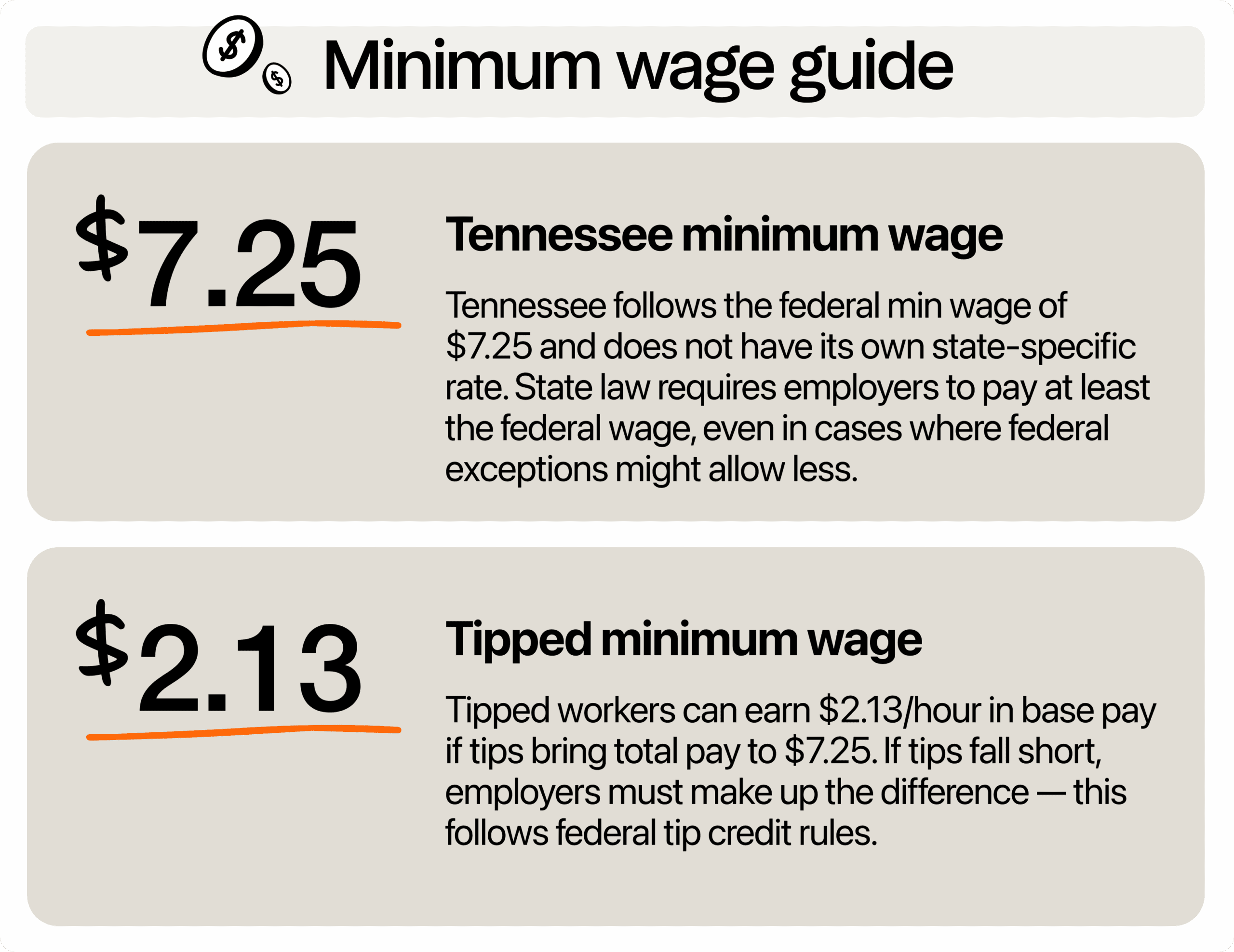
In Tennessee, the minimum wage is $7.25 per hour, which matches the federal rate. And while the state doesn’t have its own minimum wage law, T.C.A. § 50‑2‑114 says employers must pay at least the federal rate to all workers, even if federal rules say they could pay less. As a result, Tennessee businesses can’t use some of the subminimum wage exceptions allowed under federal law.
This includes most kitchen and FOH staff. It doesn’t apply to exempt roles (like certain salaried managers), but most hourly workers fall under it.
There are still a few exceptions. Tipped workers, like servers and bartenders, can be paid $2.13 per hour in direct wages but only if tips bring their total pay up to at least the minimum. If a worker doesn’t make enough in tips during a shift or pay period, the employer must cover the difference. This is part of the federal tip credit rules, which Tennessee follows in full.
Also, youth workers under 20 may be paid $4.25 per hour during their first 90 days, but only if they’re in non-tipped roles and this rate still meets all applicable wage laws.
Tennessee also doesn’t have a separate state law for overtime. So, the federal Fair Labor Standards Act (FLSA) applies. This means non-exempt workers must get paid 1.5 times their regular rate for any hours worked over 40 in a single week.
How does Tennessee’s minimum wage compare to neighboring states?
Tennessee’s minimum wage is the same across most surrounding states. But a few neighbors pay much more. Just across the border in Arkansas, the state minimum wage is $11 per hour.
Further north in Missouri, workers earn $15 per hour minimum, which is over double Tennessee’s rate. In Virginia, the state minimum wage is $12.77 per hour this year. Unlike Tennessee, Virginia pays the same base wage even for tipped workers.
Meanwhile, Kentucky, Georgia, North Carolina, Alabama, and Mississippi also rely on the federal minimum rate.
If your restaurant is in Memphis, Tiptonville, or Kingsport, workers may be tempted by higher pay just a short drive away. That can make hiring or retaining staff tougher.
On the other hand, if you try to match wages to keep talent, labor costs can jump significantly, from $7.25 to $12 or $13. That adds up fast and affects your bottom line.
Are there plans to increase the minimum for workers?
There’s no state law currently moving forward to raise the minimum wage above $7.25 per hour. Attempts to pass wage hikes have failed several times.
For example, in 2022, Senate Bill 2670 proposed raising the wage to $15 per hour. It stalled in the Senate Commerce and Labor Committee and died before reaching a vote.
From 2023 to 2024, SB 940 proposed a $12 per hour wage. But it died in committee, never advancing from the Banking & Consumer Affairs committee.
More recently, in 2025, lawmakers introduced HB 1216 and SB 1190, each calling for a $20 per hour wage or the federal rate, whichever is higher. Both bills failed in committee in March 2025, in the Banking & Consumer Affairs and Senate Commerce panels.
At the federal level, there is a national bill under consideration. The Raise the Wage Act of 2025 proposes raising the federal minimum wage to $17 per hour by 2030, while phasing out lower subminimum wages for tipped workers, youth, and people with disabilities
If passed, it could impact an estimated 22 million workers, adding roughly $70 billion in annual wages and boosting the average affected worker by about $3,200 per year. So far, though, this bill hasn’t passed, and its future remains uncertain.
2026 Labor Costs Playbook
Increase your bottom line with insights from over 500 restaurant pros—learn the true cost of employee turnover, the best way to manage labor costs, and proven strategies to protect profits.
What strategies can one use with this information on Tennessee’s minimum wage?
Knowing the state rate information is just the start. You can choose to pay more so that you attract and keep top talent in a competitive market. However, if you can’t pay over the applicable minimum yet, there are strategies you can use to keep your team happy while managing labor costs.
Create a competitive edge through pay transparency
Being open about how you pay can give your restaurant a powerful advantage. It earns trust, boosts loyalty, and helps you stand out. If you pay more, include it in job postings and on your website.
On the other hand, if you can’t match nearby states’ wages, explain your total compensation package. Highlight non-monetary benefits like flexible scheduling, career development opportunities, free meals, training programs, or performance bonuses. By focusing on holistic compensation, you can set your restaurant apart and improve employee retention.
Transparency isn’t just about base pay. If your line cooks can earn up to $12 per hour after six months, or your FOH staff can move into shift leads with pay bumps, make sure potential hires and your current team know about it.
You can create a pay chart and post it in the break room as well as job ads. It can show starting wages for dishwashers at $9 per hour, line cooks at $10 per hour, and average tips that pushed servers above $18 per hour most weekends. It can also outline how employees could move up every six months based on performance and training.
The point is to show your team that there’s a clear path for growth and increased earnings. With a transparent, well-structured compensation strategy, you demonstrate that you value your employees’ skills and potential.
Offer non-monetary value
Offering perks, like flexible schedules and clear promotions, can help attract and keep high-performing employees. In our restaurant employee engagement report, 62% of workers said that flexible hours improve their job satisfaction.
Giving flexibility helps workers plan around personal needs. You can offer this perk by opening morning or afternoon-only shifts. This approach can be especially attractive to students, parents, or those juggling multiple jobs.
Aside from flexible hours, employees also want to see how they can move up in your restaurant. Even if you have a single branch, you can create a clear career progression path.
Define roles like shift lead, assistant manager, and manager. Make sure to outline specific skills and performance metrics required for each level. Then, provide training opportunities that help employees develop these skills.
Consider creating a mentorship program where experienced team members guide newer staff. Experienced staff can share insights about workflow, customer service techniques, and industry-specific skills.
More than transferring knowledge, it also builds a sense of community within your restaurant. This creates an environment where newer employees feel supported and, hopefully, they’ll see a long-term future with your business.
Adjust staffing strategically
Tennessee wages may have stayed flat, but you’re certainly spending more on restaurant costs, like ingredients, rent, and utilities. Make every labor hour count by monitoring how you create schedules and whether your staff is deployed efficiently.
First, analyze peak and slow hours. Track guest counts and sales throughout the week to identify exactly how many people you need per shift. If your Friday dinner rush runs from 5 p.m. to 8 p.m., but foot traffic drops afterwards, consider reducing staff after 9 p.m.
Additionally, instead of running full 8‑hour shifts during slower times, offer part‑time or split shifts. For example, you can schedule one employee from 11 a.m. to 3 p.m., and another from 5 p.m. to 9 p.m. This way, you can reduce overlapping hours while still maintaining adequate staffing during busy periods.
One thing to look out for with split shifts is potential wage and hour compliance issues. Split shifts can trigger additional minimum wage calculations and overtime considerations. Use reliable restaurant scheduling software to track hours meticulously and stay compliant without spending too much on unnecessary overtime.
Communicate shift expectations as well. Offer guaranteed minimum hours, like 20 to 25 hours per week for part-time staff. This alleviates your team members’ concerns about income instability.
Keep training your staff
Investing in regular training equips your team to work faster, smarter, and more confidently. With this, you can get more value from every hour on the clock.
Focus your training on high-impact areas like menu knowledge, upselling techniques, safety procedures, and using your POS system efficiently. Cross-training is especially helpful for you.
In fact, around 68% of restaurants have already used cross-training as a labor management strategy. When servers know how to prep or hosts can handle takeout orders, you stay flexible during shift changes or callouts.
Another option is to have short weekly refreshers or quick pre-shift huddles. These help reinforce skills without pulling staff off the floor for long.
How can small business owners prepare for wage changes in TN?
There might not be a wage increase on the horizon yet in Tennessee, but small business owners need to be prepared in case it does happen. Check the U.S. Department of Labor and Tennessee State Government websites for updates on labor laws.
Next, audit how you pay your team now. Make sure every worker earns at least $7.25 per hour, including tipped workers. The right payroll software can help you track data and review previous pay records to benchmark wages across different positions.
You can then compare current compensation against potential future minimum wage scenarios. Build financial projections that account for potential increases, so that you can see how these might impact your overall labor costs.
As much as possible, set aside a small contingency fund to absorb adjustments without worrying about sacrificing your restaurant’s financial stability. For instance, you can set aside 3% to 5% of your monthly revenue as a buffer.
It might seem small, but this emergency fund can give you enough time to catch up and recalibrate your business strategy. By planning proactively, you minimize budget surprises that could derail your operations.
You should also talk to your team regularly. If wage changes are being discussed at the state or federal level, let your staff know you’re paying attention. Again, transparency builds trust, and it helps your team feel more secure about their future in your restaurant.
Use surveys or quick check-ins to understand how your employees feel about wages, schedules, and growth opportunities. This insight helps you make decisions that support your team and protect your business.
Employees who feel included in the bigger picture are more likely to stay committed, especially if they know you’re listening to their concerns. Taking time to gather feedback strengthens your relationship with them and helps you spot potential problems early. As a result, you can make smarter, people-focused decisions.
Stay one step ahead
Tennessee’s minimum wage may not be going up yet, but that doesn’t mean you can afford to sit still. As a small business or restaurant owner, planning ahead can save you from big headaches down the road. The key is knowing your numbers, understanding your staff’s needs, and having systems in place to respond when laws or labor costs change.
Don’t forget to plan for the future, too. If federal lawmakers pass a wage increase in the next few years, your payroll could jump quickly. Use dedicated restaurant management software to schedule, track wages, and distribute tips efficiently. More importantly, tools like 7shifts provide real-time data to help you make smart decisions that maximize your restaurant’s profitability.

Rebecca Hebert, Sales Development Representative
Rebecca Hebert
Sales Development Representative
Rebecca Hebert is a former restaurant industry professional with nearly 20 years of hands-on experience leading teams in fast-paced hospitality environments. Rebecca brings that firsthand knowledge to the tech side of the industry, helping restaurants streamline their operations with purpose-built workforce management solutions. As an active contributor to expansion efforts, she’s passionate about empowering restaurateurs with tools that genuinely support their day-to-day operations.