
If you’ve worked in restaurants long enough, you’ve seen it happen.
A great server suddenly quits. Your strongest line cook gives notice. The host who knew every regular by name disappears from the schedule. And then comes the scramble of posting jobs, training replacements, covering shifts, and hoping the next hire sticks around longer than the last one.
Turnover is one of the restaurant industry’s biggest challenges. Every departure costs time, money, and ruffles the team. But what if the things employees want most are the same things that help restaurants succeed?
ICYMI: we surveyed more than 1,000 restaurant workers across the U.S. about what motivates them, what stresses them out, and what makes them stay. The results offer a clear picture of what today’s workforce is looking for, and what operators can do to build workplaces people don’t want to leave.
On the menu
5 min read The work bestie retention strategy
 Horrible bosses, backed by data
 Training on training
If you’ve seen this play a few too many times… this one’s for you. Read on for the top turnover reasons + how to take action fixing it!

By the numbers
A snapshot of today’s restaurant workforce:

72%
of employees are happy at work (which means over 1 in 4 aren’t)

65%
have quit a restaurant job at least once… and 7% are planning to do so

28%
see their schedules only a few days out, while 75% want it one to two weeks ahead

Really big insight
Your team can be a bigger motivator than a paycheck
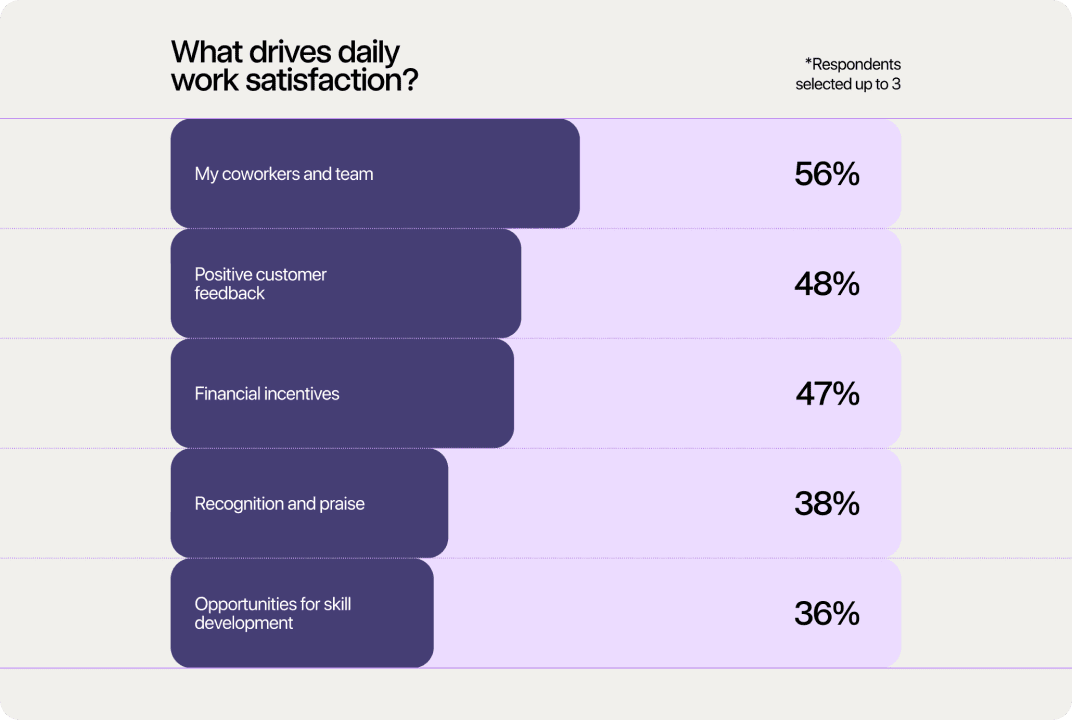
Money matters. But according to restaurant workers, it’s not the biggest reason they show up every day. When we asked what motivates them day to day, coworkers came out on top. More employees said their team motivates them at work (56%) than positive customer feedback (48%) and financial incentives, like tips and bonuses (47%). And among workers who describe themselves as happy, 84% say they feel connected to their coworkers.
That’s not to say pay doesn’t matter—it absolutely does. But our data suggests that once the basics are covered, people stay for the people. The restaurants with the strongest teams create something that’s hard to put a price on: a workplace where people actually enjoy being there.

Really big insight
People don’t just quit jobs… they quit managers
When restaurant employees leave, money gets most of the attention. But the data suggests there’s another factor operators should be paying just as much attention to: management.
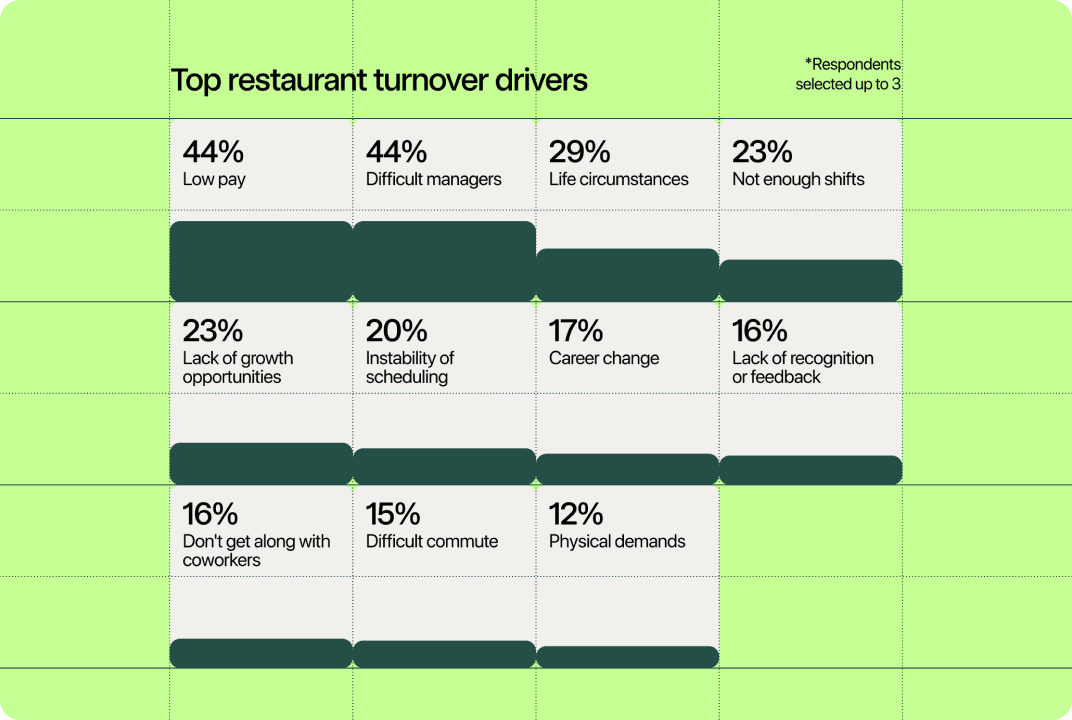
Among employees who’ve quit a restaurant job (or are planning to), difficult managers tied with low pay as the top reason, both cited by 44% of workers. And 73% say their relationship with their manager impacts their job satisfaction, including 41% who say it influences it a great deal.
In many restaurants, managers come up through the line—they’ve been servers, bartenders, or cooks first. But stepping into leadership is a different job entirely. Running a shift and supporting a team day-to-day requires a different set of skills: coaching, communication, and people management. And that set of skills requires the proper investment as well.
We asked Justin Khanna, Chef, Restaurant Content Creator, and Founder of Repertoire, what it takes to be a good manager. His thoughts:
🍽️ Work for your team:“This doesn’t mean do the work for them, but identify bottlenecks they’re experiencing, frequently-experienced issues you can eliminate, and spend your time building workflows and systems to make the entire team perform better.”
🎯 It’s your fault:“I know that sheet tray of onion chips that just burned in the oven wasn’t put there by you, but it’s an interesting reframe to put in perspective what you can do to influence the outcomes from your team. Instead of placing blame, you ask yourself how you factor into the results that you’re seeing. Sitting with this might make you reconsider your approach to training, organization, and communication.”
🚫 Cruelty is off the table:“In the context of communication: Cruelty = actively desiring to do harm to someone. Kindness = actively desiring to positively impact someone. It’s a spectrum. You might have an interaction that’s not technically ‘kind’ and it might land in a neutral space between the two, but making a conscious decision to never be cruel was a foundational principle that helped me avoid situations I regretted as a manager.”
Building off that, here’s some top-voted employee POVs on what makes a good manager from a recent Reddit thread:
r/restaurateur
u/rickytickee
I view a manager like a chef in that a chef should be able to work every station. A good manager can lead by example. They should be able to run the door, take a section, three carry plates, explain every dish, cocktail, WBTG, and also train staff properly. A manager that can admit when they make a mistake also says a lot about their character. We are human after all…In a world slowly being taken over by robots and AI. Its important to give grace to each other.
r/restaurateur
u/landmermaid3
Communicate! I want to know what I’m slacking on. I can’t stand jobs that wait until yearly reviews/termination to tell employees what they’re doing wrong. Address your concerns asap. Let me know what I’m doing good at so I can keep doing it! Be present! My last job had to make a rule for managers to be on the floor from 5-8. It was a restaurant with 10 locations and every manager would hide in the office. It’s a hands-on job. Trickle down! By having a good manager, I’ve become a mini manager. The support staff is comfortable coming to me with problems. Sometimes I refer them to our boss, and sometimes I say ‘what do you mean the pint glass broke while scooping ice?’ and help fix the problem. It’s more symbiotic than other places. Don’t be a tyrant. Act like a staff member and it should be good!

Really big insight
The best training happens on the floor
When it comes to training, restaurant workers are clear: show me, don’t just tell me. Hands-on learning from managers is the top preference (63%), followed by shadowing senior employees (49%). But structured courses still have a real place in the mix—nearly 1 in 4 workers prefer them, pointing to a clear appetite for more organized, repeatable training alongside on-the-floor learning.
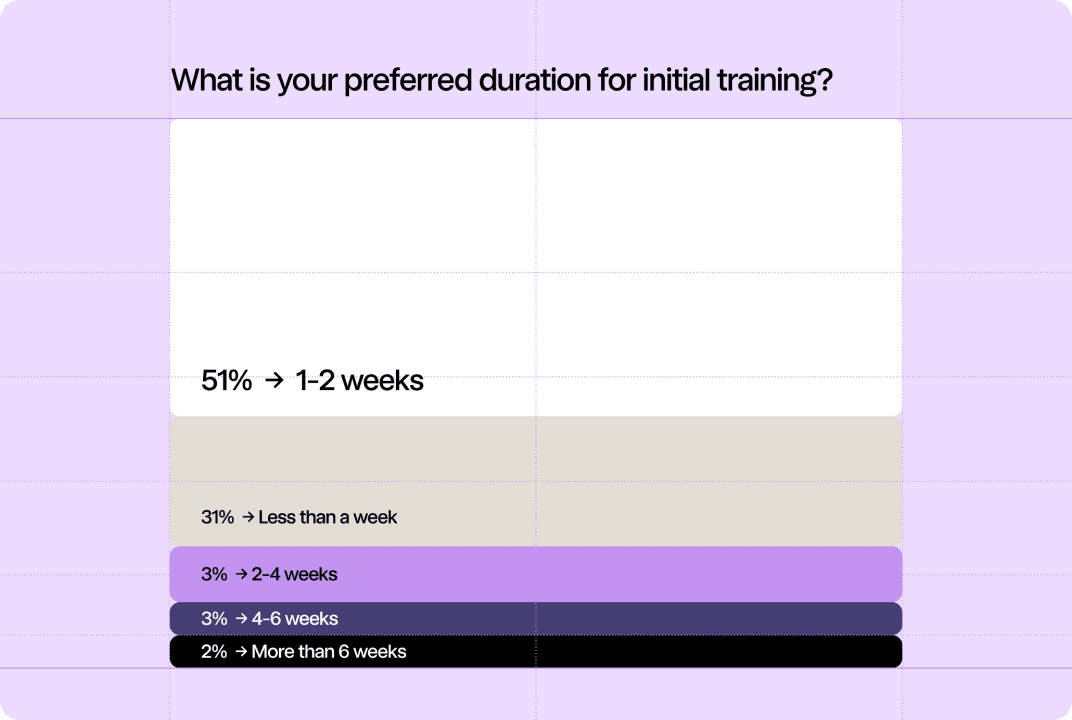
Timing matters just as much. Over half of employees say the ideal onboarding window is one to two weeks, and another 31% want to be fully up and running in under a week. In other words, workers want to learn fast… but not without the proper support on the floor.
We tapped Jason Berkowitz, founder of Arrow Up Training, for a few quick, real-world training tips from working directly with restaurant teams:
✔️ Make day one count: Set goals, walk through the schedule, and orient new hires early (can improve retention by ~30%).
✔️ Don’t wait 30 days to judge fit: Employees decide how they feel about a job on day one, even if owners typically give it a 30-day trial.
✔️ Train your trainers: Maximize learning by giving leaders the tools and skills they need to communicate clearly and coach consistently.
✔️ Keep training fast + engaging: Short videos, interactive tools, and even memes or GIFs help reinforce learning in fun ways.
✔️ Encourage leaders to share stories: Empathy and real experiences make new hires more comfortable learning on the job.
✔️ Standardize the basics: Documented processes reduce inconsistency (and frustration) across trainees.
✔️ Repeat key messages: Micro-reminders and refreshers can beat one-time training sessions.
✔️ Show what good looks like: Tools like Meta glasses can help capture amazing first-person training POVs.
Want the full picture on what employees want?
All the data is free, ungated, and built for operators who’d rather know than guess.
See the report